
Rowe & Walton PC
Rowe & Walton PC
The Quick Answer (TL;DR)
Let’s be honest. When you finally signed that thick stack of papers to create your family trust, you probably breathed a massive sigh of relief. You did the responsible thing. You protected your family, bypassed the nightmare of probate court, and checked a major task off your to-do list.
Then, you likely put that binder in a drawer or a safe and haven’t looked at it since.
Here is the hard truth that most people don’t realize: A trust is not a “set it and forget it” document. It is a living, breathing set of instructions. Think of it like a garden. If you plant it and walk away for a decade, it’s going to become overgrown and messy, and it’s going to fail to produce what you want.
If your trust is more than 5 years old, it is highly likely to contain critical blind spots. At Rowe & Walton PC, we routinely review older estate plans for families in the Bountiful area, and we consistently see the same three dangerous traps.
A trust only has power over the assets it physically owns.
We call this “funding” the trust. When you first created your plan, your attorney likely helped you transfer your house and your primary bank accounts into the trust’s name. But what has happened since then?
Did you refinance your house? Buy a cabin? Open a new credit union account? Inherit some money? Start a new investment portfolio?
If you acquired new property or opened new accounts and forgot to title them in the name of your trust legally, those assets are completely unprotected. If you pass away tomorrow, those specific items will be forced to go through the public, expensive, and time-consuming probate process before your family can touch them. Your trust is essentially an empty vault—it only protects what you remember to put inside.
(Note: Never put retirement accounts, such as IRAs or 401 (k) s, directly into a trust without speaking to an attorney, as this can trigger a massive tax penalty.
Think about who your kids were when you drafted your trust. Now, think about who they are today.
Many older trusts were designed with minor children in mind. You likely named them as concurrent beneficiaries to ensure they were supported if something happened to you. But if your kids are now adults, leaving those old provisions in place is a massive liability. If a grown child has an active legal interest in your trust while you are still alive, their legal problems can suddenly become your legal problems.
Updating your trust allows you to adapt to who your children are today. A modern trust review allows you to build in legal fortresses that protect your child’s inheritance from:
Furthermore, if a child or grandchild has developed special needs, receiving a direct inheritance could accidentally disqualify them from vital government benefits like Medicaid or SSI. A quick update can fix this instantly.
What constituted a brilliant legal strategy in 1999 is often a massive liability today.
For decades, attorneys drafted trusts using complex “A-B” or “Credit Shelter” formulas. The goal was to avoid the federal estate tax, which used to kick in at a much lower threshold. However, federal tax laws have changed drastically. In 2015, the exemption limit skyrocketed, making these old tax formulas completely obsolete for the vast majority of middle-class and upper-middle-class families.
Why does this matter to you? Because those old formulas often force the trust to become strictly irrevocable the moment the first spouse dies.
Suddenly, the surviving widow or widower is legally locked out of making changes. They might be barred from selling a property, altering beneficiaries, or even obtaining a reverse mortgage to pay for in-home care. Additionally, older trusts designed to protect assets from Medicaid recovery for nursing home costs may completely fail under today’s strict, modernized Medicaid look-back laws.
You worked your entire life to build your estate. Don’t let an outdated, dusty binder dictate your family’s financial future.
Because life evolves and laws shift, reviewing your trust is the only way to ensure your ultimate wishes are honored. You need local, experienced eyes on your documents—someone who understands both the nuances of Utah law and the realities of modern family dynamics.
At Rowe & Walton PC, we don’t just draft paperwork; we build lasting peace of mind. We can comb through your old documents, identify hidden gaps, ensure your assets are properly funded, and modernize your plan so it works exactly as you intend.
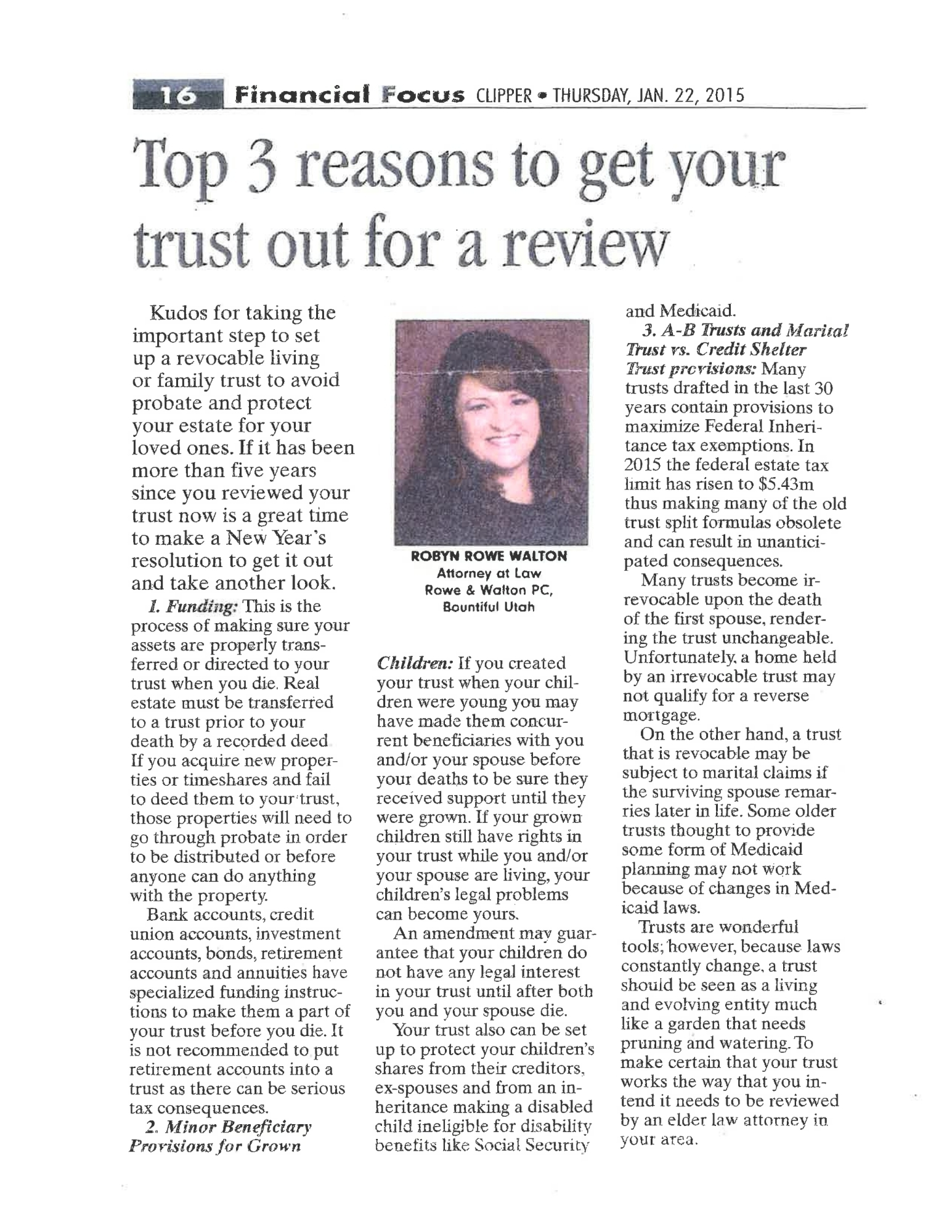
Contact Robyn Rowe Walton, Attorney at Law, to schedule a comprehensive review of your estate plan today.