Rowe & Walton PC

Building a Comprehensive Roadmap for Your Special Needs Loved One

Rowe & Walton PC

Building a Comprehensive Roadmap for Your Special Needs Loved One

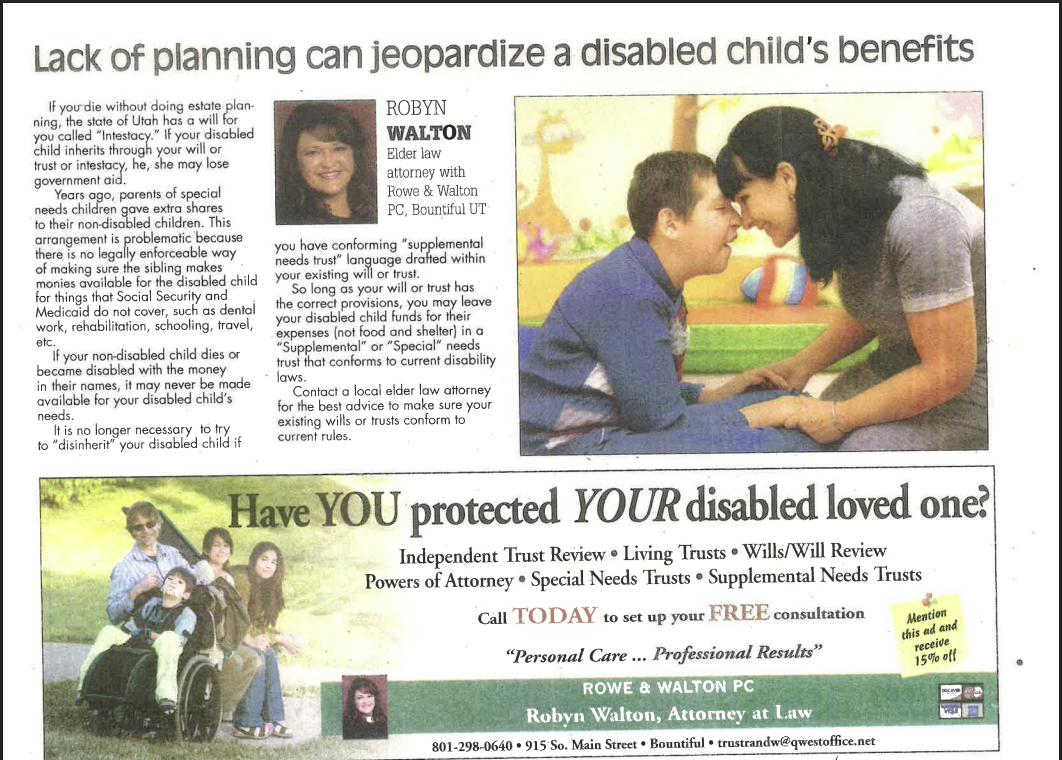
In her previous article, attorney Robyn Walton emphasized that leaving an inheritance directly to a disabled child—or to a sibling on their behalf—can lead to a loss of essential government aid like Medicaid and Social Security. To avoid this, a “conforming” trust must be drafted within your estate plan.

However, a trust is only one piece of the puzzle. To provide the best possible future, families should consider how multiple tools work together.

1. The Power of the “Pair”: SNTs and ABLE Accounts

While a Special Needs Trust (SNT) is ideal for managing large assets, such as an inheritance or life insurance proceeds, it is often most effective when paired with a UTAH ABLE (529A) Account.

  • The SNT for Long-Term Security: There is no limit on the amount of money an SNT can hold, making it the primary vehicle for preserving a family legacy.
  • The ABLE Account for Daily Autonomy: ABLE accounts allow individuals with disabilities (whose disability began before age 26) to save up to $19,000 annually (as of 2025) without losing SSI or Medicaid.
  • Better Together: A trustee can transfer funds from an SNT into an ABLE account, giving the beneficiary more day-to-day control over spending for “qualified disability expenses” like transportation and even housing, which can sometimes be more restricted within a trust alone.

2. Understanding “Third-Party” vs. “First-Party” Trusts

The planning Robyn Walton describes typically involves a Third-Party SNT—a trust funded with parents’ or grandparents’ own assets.

  • Third-Party Advantage: These trusts are highly flexible and, crucially, do not require a “Medicaid payback” upon the beneficiary’s death; the remaining funds can go to other family members.
  • First-Party (Self-Settled) SNTs: If a disabled individual receives their own money (such as from a personal injury settlement), they may need a First-Party SNT to remain eligible for benefits. These do require a Medicaid payback provision, making proactive “Third-Party” planning by parents much more efficient for the family’s long-term wealth.

3. The “Soft” Side of Planning: The Letter of Intent

A trust provides the financial instructions, but a Letter of Intent (LOI) provides the personal ones. Though not a formal legal document, an LOI serves as a vital roadmap for future guardians and trustees. It should include:

  • Daily Routines: What does a typical day look like? What are their favorite foods or activities?
  • Medical History: A detailed list of doctors, medications, and therapists.
  • Social Hopes: What are the family’s dreams for the individual’s social life, education, and living arrangements?

4. Navigating the Transition to Adulthood

When a child with special needs turns 18, they are legally considered an adult, regardless of their disability. Families should consult with an attorney about:

  • Guardianship or Conservatorship: For individuals who cannot make their own medical or financial decisions, a court-ordered guardianship may be necessary.
  • Power of Attorney: If the individual has the capacity to sign documents, a Durable Power of Attorney and an Advance Healthcare Directive may be a less restrictive alternative to guardianship.

Your Next Steps

As Robyn Walton noted, “Lack of planning can jeopardize a disabled child’s benefits”. Because every family’s situation is unique, a standard form is rarely enough to protect a loved one’s unique life.

If you have questions about how to integrate a Special Needs Trust with other planning tools, contact Rowe & Walton PC at 801-298-0640 for a consultation to ensure your existing wills or trusts conform to current disability laws.